Search This Blog

Showing posts with label Nell. Show all posts

Saturday, 30 June 2012

26. Into the 1950s.

By the 1950s Bert's life was settled and more comfortable than it had been since the years before his father died. He was wiry and active. He had given up smoking. The only beer he indulged in was Horehound Beer, a non-alcoholic drink purchased every now and then from a stall in Sydney's Central Railway. His children said this was all Nell would allow him, but Bert was a follower of health foods, and Horehound had a long history of association with the English mineral water business that Bert's family had been a part of.

Bert also had raisin sandwiches, banana sandwiches and bread and honey most days - certainly his own choice, not shared by anyone else in the household. He had a 'fizzy drink' each day after his evening meal - Alkasetzer - to aid his digestion. On weekdays Bert drove to work early. On his way home he often stopped to see Grace, still living in Mascot, and estranged from her mother.

Nell had the evening meal on the table at 5.00pm. If Bert was late, his meal was in the oven of the coal-fired stove. Bert was mostly home before 4.00pm, working in his shed. Just before 5 he would come into the house and wash-up in the large bathroom, scrubbing his hands with solvol, lathering again and again, pushing the lather down each hand until it was clean.

After the evening meal, he and Nell retired to the sitting room, in front of the radio. Nothing came between Bert and the radio serial, When a girl marries. 


There were celebrations with the Harris's - their friends from the Orontes - or with Fred and Clare - around the pianola.

Bert had a permanent booking on Saturday nights at the Botany Empire Cinema - upstairs, first row on the right, a double seat. He and Nell rarely missed.

On weekends there were still the drives into the bush. Sometimes Nell would spot a plant in the scrub and call for Bert to stop. She would dash into the bush, dig up or snap off enough to try growing it in her bush-house. Bert still grew vegetables and flowers for home consumption and Nell kept chickens.

Bert paid for Sylvia's two children to be born in the Pacific Private Hospital in Brighton-le-Sands, perhaps hoping to prevent his daughter having the difficulties that had plagued Nell's pregnancies.
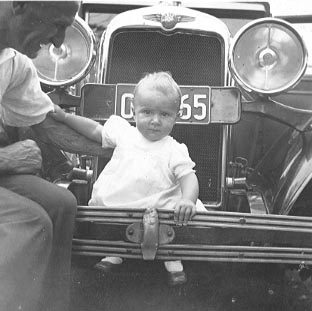


Bert badly wanted a grandson. When Sylvia's first baby, born in 1947 was a girl, Bert refused to look at her for a week, and called her 'Sonny Jim' for 16 months until Sylvia obliged with a boy.


He was always kind to his granddaughters - but in his world a boy was what counted.

He had no time for women drivers, women in public life, or education for women.


Albert's photography business thrived in the 1950s, leading to Albert becoming the photographer for Woolworths in Sydney, near the Town Hall. He had a small studio there were he took photos, which he developed in a darkroom near Central Railway. Irene learned to colour the photos and Beryl served as receptionist.


Grace and Brenda Grace

Grace and Sid had a daughter, Grace Brenda, born in 1949. Sid worked at the Bunnerong Power Station, near the Botany Bay heads.
Bunnerong Powerhouse from Banksmeadow School 1940


In 1953 Sylvia and Len bought their own home in Livingstone Avenue Botany, the same street that the family had lived in when Bert worked on the Banksmeadow retaining wall. Bert and Nell drove over to visit on most Sundays, sometimes staying, sometimes taking everyone on the routine drive to the bush.


In the school holidays Nell and Bert would take Sylvia and her children on day trips to places like the Captain Cook landing place at Kurnell.

On the way home, Bert always stopped to buy ice-cream for everyone - vanilla between wafer biscuits.

Saturday, 16 June 2012

21. Bonnie Doon Nursery

Nell and Bert in Bonnie Doon Nursery
Bert and Nell put all their energy into establishing a nursery. They raised seedlings to sell in Paddy's market each Friday, along with flowers and a few vegetables.. They did everything themselves - creating the products they could sell.


Bert in his shed with boxes of seedlings

Bert brought fruit boxes home from the market on Friday and turned them into seedling boxes.


The children were expected to help, particularly pricking out the seedlings, a task the older children hated, but Sylvia, the youngest, was happy to do.


The back of 98 Banksia St house with seedling beds


 It was relentless, demanding work.


Albert got a job at Bailey's Tannery, but was expected to help out after work and on weekends. He hated it and wanted to be out with his friends - and with girls.

Bert and his dahlia crop


Grace worked in the nursery and also "went into service" as a domestic help to a family at Brighton-le-sands.

Bert was known to friends and others outside the family, as 'Ted', from his second name, Edward. Nell, his mother, sister and brothers, always called him Bert, and he had no trouble moving between the two. It was as if he kept his life in two compartments. The names rarely crossed over.


Bert needed a truck to get his products to market. He enjoyed driving and tinkering with the truck as much as he enjoyed the cultivation of plants.


He also loved and kept dogs, most bought in Paddy's Markets.

Albert and Grace with friend Tommy Meehan


 Albert and Grace joined the Methodist Church's Youth Group and made many friends. Albert went fishing and rabbiting with mates from work and also from the church group.

Albert fishing at Cronulla


Grace, Nell and Albert at Banksia St c. 1935


They were finding their feet in Australia and wanting their own lives and independence. They were also throwing off the constraints of the Great Depression.

Wednesday, 13 June 2012

20. Australia in 1930

The Orontes arrived in Fremantle on 25 November 1929 and in Sydney about ten days later. In the six weeks it took the Orontes to reach Sydney, the impact of the October Crash of the New York Stock Exchange was being felt in Australia in job losses. Unemployment had been just above 10% in October 1929. By mid-1930 it was 21% and Bert was amongst the unemployed.

Nell, Albert, Grace & Sylvia, Sutherland St.
Bert's sponsored job evaporated before the Orontes docked. Fred and Les, Bert's two single younger brothers, gave up their jobs in favour of Bert, but even that one, shared, job dried up as the country sank rapidly into Depression.

The family found accommodation in Mascot, first in Roby St, then  at 136 Sutherland St.

In 1930 there was no unemployment benefit scheme in Australia. In 1929 the Federal Government made £1 000 000 available to the States to use unemployed workers to undertake roadworks. In July 1930, the Federal Government, led by Scullen,  provided a further £1 000 000 to the States for Public Works, using the unemployed.


Fremlin St Flooding 1930. Sir Joseph Banks Hotel in background
In 1930 storms and high tides caused substantial flooding in houses along the shores of Botany Bay.


Sea wall construction Sir Joseph Banks Park.


The NSW  Government used part of its Federal Public Works money to build a retaining wall along the Botany Bay foreshore at Sir Joseph Banks park to prevent further flooding.

Banksmeadow retaining wall 1948


Bert got work under this scheme, labouring to build this retaining wall at Banksmeadow.


The wall is still there.


View over Botany Bay from Tenterden Rd, 1938.
The family moved to Botany, first living in 2 Livingstone Avenue, then in Tenterden Rd. Sylvia attended Banksmeadow Primary School. Botany in 1930 had a lot of open space. It must have looked a little bit like the Isle of Sheppey where Nell spent her early childhood.

They lived frugally - eating their share of bread and dripping, while Nell saved for furniture.


In 1933, Bert and Nell moved to a rented house at 98 Banksia St Botany. 96 Banksia Street, a block with no house but a large shed, came with the rent. Here Bert set up Bonnie Doon Nursery and went into business.

Saturday, 5 May 2012

14. Last Year of War - France

A large number of WWI service records are missing, believed to be lost in a fire. Amongst those missing are Bert's and those of his Captain, Clement Bailhache. This makes it difficult to piece together exactly what happened to them in the last 18 months of the War.

Family stories say that Bert first saw his daughter, Emily Grace, known as Grace, when she was 2. For that to be so, he must have had leave between May 1917 and April 1918, more likely in 1917. We know that the British Army withdrew troops from Salonika from June 1917, although the 3rd Battalion Royal Fusiliers remained there until June 1918.

The photo of Bert and his family, Nell, Albert and Grace, could not have been taken long after Grace's 2nd birthday, which was late in May.

It also seems that two of Bert's brothers, Sydney and Stanley, had enlisted, for a photo of the Emily Grace Ray's family was taken at the same time. Bert's son, Albert, documented this photo as Emily Grace Ray and her children.

The men would be, from left, Bert, Fred, Les, Stan and Sydney, with Emily Grace Ray centre with the young Albert, and Doll seated right.


Amongst Bert's possessions was a postcard he had sent to Nell from Orange, South of Paris. The military postmark bears no date, but Bert has dated it 15 June 1917.  It reads " Just arrived here. The weather is quite hot. We have just been having a feed of oranges and cherries. They were grand. Hope you are quite Well (you know). With my best love, Bert."


From this, it seems likely that Bert has arrived in France after leave in England and is hoping that Nell is pregnant again. No child survived from this time, but we do know that Nell had a three miscarriages or still births between 1917 and 1929.


Also amongst Bert's possessions was a book of postcards of the Somme.

Although the 3rd Battalion was still in Salonika, numerous other Fusilier battalions were fighting on the Somme in 1917, and receiving reinforcements from wherever the Army could find soldiers.


Many of the postcards are of Peronne. All emphasise the destruction by the Germans.


 Even though these must have been purchased some time after the event, it seems likely that Bert took part in battles in this area, but this is hard to verify without the missing records.


The 3rd Battalion, Royal Fusiliers, arrived back in France through Dieppe in July 1918 and rested and trained there for two months. Bert may have rejoined his regiment there. He kept several postcards of Dieppe and its environs.
 On October 3 the regiment marched North as one of the battallions of the 149th Brigade 50th Division. They marched through the night of 3 October and at 6.10am on 4th October they advanced down the slope of the Scheldt Canal, up the valley on the opposite side to take Richmond Copse.

They made a clean sweep by 7.30 am, taking 300 prisoners from machine-gun teams but then had to retreat because they found themselves isolated. The 4th Kings Rifles were able to recover the ground that evening with little German resistance. The Fusiliers had lost ten officers and there were 139 other-rank casualties.


The regimental historian, H. C. O'Neill says:
Few actions of the Fusiliers had been more tragic. Many had been more costly, but few had carried the troops to their objective only to see them compelled to fall back almost to the starting point with the bulk of their leaders killed. The Royal Fusiliers in the Great War (p319).

On October 17 the Battalion took part in the Battle of the Selle to open up a ten mile front between Benin and St. Souplet. By now the battalion consisted only of 11 officers and 308 men and in this one day of battle lost 98 officers and men.

The final action of the War for the battalion was on 8th and 9th November 1918, pushing through the Forrest of Beugnies under machine-gun fire. They withdrew to billets at Mont Douriers on 9 November and were there when the Armistice took effect on 11 November 1918.