Search This Blog

Showing posts with label 1940s. Show all posts

Thursday, 5 July 2012

28. News from England


Amongst Bert's papers there are eight letters from his mother, Emily, between 1947 and 1952 and one Christmas Airgraph letter from 1943. In 1943, Bert's brother Syd is still in the Army, along with his son, Sydney and Doll's son, Jack. Emily is living with Les in Hendon, but visiting Hounslow often.

It would seem that few of Emily's letters to Bert were answered. Grace wrote to her grandmother during the War and sent her food parcels but Bert, although quite literate, was a poor correspondent. Emily's letters are a mixture of family news - mostly about her brothers and sisters - news about rationing in Britain, questions about Bert's family and pleas for more news and photos.


In 1947 her letter is sent from Stan's house at Prittlewell, Southend-on-Sea. From 1948 to 1951 she writes from Brookfield, the home she bought with the sale of the mineral water business, now leased by her brother Charles and his family. From 1947 until 1952 Emily lived with her brother, his wife Kate and unmarried son, Charlie. When Kate died in 1948, Emily kept house for Charles and Charlie.

In 1947, aged 79,she writes : You will be sorry to hear that Aunt Kate passed away 26 July. She had been a great sufferer for some years but we all miss her very much. Poor old Uncle seems lost without her. Young Charlie is still single and living at home. I do the cooking for them at present. Glad and Ted come in to do the rough cleaning,  and washing Glad takes home to do, but I really do not want the job now. I feel too tired now to do much work. I still have a lot of muscular rheumatism and I find the stairs trying.


She passes on news of her family - the Keens, her sister Alice, brother Dick and Charles' son Arthur.


Doll lives nearby and sees a lot of her mother. She has news of Les from New Zealand when he moves there in 1947. By 1949 Les has bought 2 acres of land and is starting out on his own.  Syd and Stan are sporadic in their visits and she yearns for news from Bert and Fred. What news she does get comes mainly from Bert's daughter Grace and very occasional letters from Fred and Bert.

She has news of cousins' children marrying, and uncles and aunts aging and her own activity.


In 1951, news of her sister Alice's death is overshadowed by the death of Doll's husband, Fred. He had been ill and in hospital, but expected to live for some years if he took things carefully. Doll's grief is exacerbated by her daughter, Meg, moving to New Zealand in 1952, along with her family. Les put them up until they bought land and put up a garage they could live in while building a house.

Emily would like to be independent herself, but sees no way of achieving it.
She organises, through Grace, for Bert's signature on a document that allows her to cash in an insurance policy she held on her children's lives.


Rationing was in force in Britain until 1954. In 1951  Emily reports: We are still rationed to meat, and only 3oz butter, ¼ lb marg, and 6 oz sugar, 3 oz bacon, 3 oz cheese a week, some weeks 1 egg and some 2. Are you able to get plenty now? What we miss most, I think, is sugar, or at least I do.


She complains, as the years go by, of rheumatism, bronchitis and a bad back. Before Christmas 1952 she has moved to live with her son Syd and his wife Flo and has been confined to bed for some weeks. She was, by then, 83 years old.

In August 1952 she sent Grace a photo of herself in the garden. She says it was taken by Maud, presumably her niece, Maud, or Molly, Keen.  She asked that Albert reproduce it for her and provide it to both Bert and Fred's families so their children 'can see what their Gran is like'. Albert obliged. He retained memories of staying with her as a boy, when she bought him a pair of trousers and put a penny in the pocket, telling if that if he left it there he would never be broke!


In spite of her news and cheeriness, her letters have a sadness and pain.
She very much wants news of her family, of their daily lives, of the small news of their hopes, fears, tribulations and joys. She asks again and again for photos. She is grateful for surviving, and getting by, but she pays the price of a mother whose sons migrate across the world for a new life in an age when telephoning is a luxury and travel is slow and expensive.


On 20 May 1953 she writes to Grace wishing her happy birthday.  She is lucid and alert - commenting on the Coronation plans and on Sylvia and Len moving into their own home.

On 21 November 1953 Doll wrote to Bert to tell him their mother has quite suddenly developed dementia and has not known any of the family for six weeks. Doll has gone to stay with Syd and Florrie to help with Emily and Stan calls in each week. Eventually Doll took Emily to live with her but, within a couple of years, could no longer cope and Emily moved into a nursing home.

Doll left Southampton on the Southern Cross  in September 1959, arriving in New Zealand on 26 October. She travelled as a tourist, but never returned to England. Her son, Jack, followed on the Rangitane in February 1960 with his wife Kathleen and daughter Sheila.

Of Emily's six children, by 1960, two were  in Australia, two in New Zealand and two in England.
Emily outlived her son Stan by several months. He died of a heart attack while drinking at the Bell Prince Hotel, Southend-on-sea on 21st January 1961, aged 61.

Emily died in the nursing home towards the end of 1961, aged 91.


Thursday, 28 June 2012

25. Bert in WWII

Bert's life during the Second World War could hardly have been more different than his life during WWI. He was now a civilian, on the other side of the world, with a grown family. By 1940 his two elder children were married and independent. Sylvia still lived at home, but was working and contributing board.

Bert with his dog, Teddy, 1940s
Hard work and frugality had resulted in a modicum of comfort for Bert and Nell. Their home was comfortable.  In their sitting room  they had a large mantle radio that Bert liked to listen to in the evenings, and they had a pianola with a collection of pianola rolls that became the centre piece of evenings with friends.

The local factories were short of labour as young men enlisted and went to war. Bert's son, although he did not enlist, was not interested in the nursery business. Bert was too much a product of the Victorian era to even consider that his daughters might be business partners in the nursery, even though both of them were interested in plants and cultivation. Women, in his world, raised children, kept house and helped out. They weren't partners, and they weren't the future of a business.

Men working at Textile Dyers and Bleachers 1940
Bert responded to the call for older men to help keep the factories working, closed his nursery, and went to work for Textile Dyers and Bleachers in Mentmore Avenue, Rosebery. He worked there until 1956. The company eventually specialised in a form of winter cotton, similar to Viyella. Workers could bring home the ends of the rolls of dyed fabric that were cut off before the rolls left the factory. Sylvia and Grace turned these into clothes and Nell hooked strip rugs for every room in the house.

Bert exchanged his nursery truck for a car. When he wasn't at work, or driving the car, he was cleaning, adjusting or tinkering with it.

Grace, Syd & Sylvia WWII
Grace's husband, Sid Molloy, had joined the Australian Navy and was at sea for much of the War. Sylvia frequently stayed with Grace while Syd was away.

In her waitressing job in the city, Sylvia met many servicemen on leave and went out with some of them. If she liked the look of the English servicemen, and they were in Sydney over a weekend, she would invite two or three of them home on a Sunday. Bert would take the group for a drive to La Perouse, Kurnell, Cronulla, Jannali and accessible 'bush'. Nell would kill and cook one of her chickens, and the evening would be spent singing around the pianola. It was a touch of 'over home' giving them news of places and developments in England.


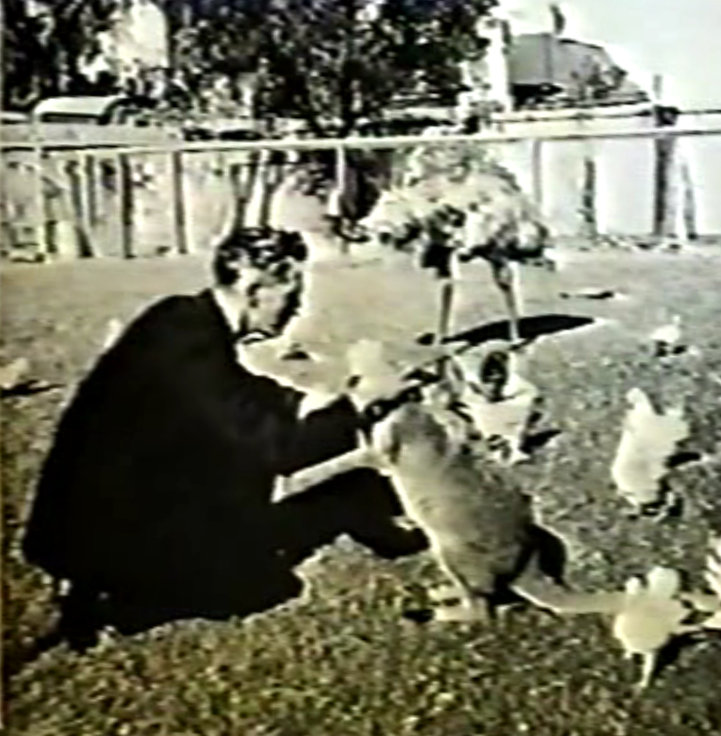
                                                    In 1940 Bert became a grandfather with the birth of Albert's daughter Irene. Bert liked children, and enjoyed taking Irene and her parents on excursions in his car, to places like the small sanctuary at Doll's Point where you could pat a kangaroo.

Letter writing rarely made it to the top of Bert's priority list. His mother wrote and asked for news. As time went by, Grace took on the task of writing to the grandmother after whom she was named.

In 1945 Sylvia met Len Haynes, a young British sailor in Sydney while his ship, the Formidable,  was repaired after kamikazi attack. They corresponded when the Formidable returned to sea, and when the War ended, Len chose to be demobilised in Sydney.

Sylvia was 20 when she and Len married in January 1946. Bert grumbled, but gave his permission when Sylvia said she would wait until she was 21 and marry him anyway.

The couple went to Lake Burrill for two weeks honeymoon, then moved into the front room of Bert and Nell's house at 98 Banksia St. Botany. The post-war housing shortage in Sydney meant they lived in this front room for the first seven years of their marriage.


At the end of the war, Albert persuaded Frank Hurley, the war photographer, to take him on as an unofficial apprentice in his photography studio in Sydney. Albert went to the studio after work each day and worked with Hurley, developing and printing photographs, learning the trade. Albert then began to photograph weddings, to do some street photography and within a few years, established his own business as a photographer. It was not what his father had envisaged, but it did display the entrepreneurial spirit of Bert's father and grandfather, and of Bert himself in his nursery business.

Monday, 25 June 2012

24. Sylvia's Childhood in Australia in 1930s

Sylvia (right) and friend at Banksia St. c. 1935
Grade 1 Banksmeadow Primary.
Sylvia fifth from left in 2nd row.
Sylvia's schooling began in the Depression and ended at the outbreak of war. She made friends at school and quickly learned about Australia. The school curriculum covered a lot of history, not just of Sydney, but of the local area. She read and learned to recite Australian poetry - mostly Henry Lawson and Banjo Paterson. She knew the sites where Cook landed and the plants that Joseph Banks identified. She joined the Gould League.


Sylvia as flowergirl c. 1934


Sylvia (right) in Botanic Gardens Sydney
Sylvia made friends easily. She had a friend with whom she sometimes stayed, who lived on a farm at Fairfield.


When she was about 11, Sylvia had an accident on a swing at school and fractured her skull. She spent several months in Rachel Foster's Hospital, where she learned to make a bed with hospital corners - something she did for the rest of her life.


with friend and friend's mother, Botanic Gardens Sydney
Sylvia didn't follow Albert and Grace to the Methodist Church Youth Group. Perhaps because of its location, close to Banksmeadow Primary School, Sylvia went to the Salvation Army hall. She loved the Salvation Army meetings, people and music. She learned to play a guitar and a timbrel.

A lot of her time was spent with Bert.She spent most of the school holidays working in the nursery and, on Fridays, accompanying Bert to Paddy's market. He taught her the mechanics of a sewing machine, how to oil one and do basic maintenance and repair.

He would not, however, agree to her continuing at school beyond the mandatory age of 14. Bert saw no point in educating a girl 'for another man to benefit'. It was an attitude that Sylvia rejected and which she spent much of her life trying to overcome.

Sylvia went to work at 14, first at Tasma Radio, Thom and Smith's factory at 919 Botany Rd., Mascot, set up in 1929, the year Bert's family arrived in Australia. Tasma Radio rode out the Depression and employed 300 people in 1938. Their radios are still collectable.

J&J workers Botany c. 1943
Sylvia then, along with her sister Grace, went to work at Johnson and Johnson's Botany factory, which was on a war footing, supplying medical equipment for the forces.


Bert  refused his permission for her to enlist in the Salvation Army when at about 17 she wanted to join. Bert prevented her ever wearing a Salvation Army uniform.

Sylvia and her friend Doris at Mark Foy's steps.


To occupy her time, and do her bit for the war effort, she also took an evening job as a waitress in the city. Sydney was full of troops and waitresses were in demand. There were English servicemen in Sydney - bringing first-hand accounts of life in England since Bert and Nell left. Bert had a car and was more than happy to show servicemen the sights of Sydney when they had weekend leave.

Friday, 22 June 2012

23. Adult and Adolescent Children in the 1930s

Albert Banksia St
Albert and Grace, Bert's two older children, came to Australia in early adolescence. The first years were hard, as the family hung on through the worst of the Great Depression, adjusting to new climate, new ways - similar poverty in new surroundings.

The experience was very different for them than for Sylvia, who began school in Australia. Albert and Grace had left school behind and needed to find their way to financial and adult independence.

Albert found work at Bailey's tannery and quickly made friends. Albert and Grace joined the Methodist Youth group in Botany and made more friends. As they both got a little money in their pockets they wanted a life other outside the work routines - and expectations - of their parents.

Albert fishing
Albert at Cronulla
Albert


Albert and his friends went fishing - staying all weekend in makeshift huts near Cronulla. Albert eventually got a boat, and sold some of the fish he caught.
With his friend Tommy Meahan, Albert took up boxing and practised at home in Banksia St - buying boxing gloves to alleviate the fear and abhorrence that Bert and Nell expressed at the damage they did to each other.

Albert on left, with mates on Manly ferry


One of Albert's favourite pastimes was taking the ferry to Manly with his mates on Sunday - dressed to kill in their striped blazers - going back and forth on the same ticket, listening to the bands that played on the ferry, and flirting with girls.
It was not a life with which Bert had much empathy.


For a while Grace helped out and home, then went into service. She worked for a while at Coghlan's Nursery.


Grace


As things improved economically, she got a job at Johnson and Johnson. She rode her bike there - never mastering, according to her sister, the back-pedal brake, and stopping when she got to work by running into the wall.


Grace, 2nd from left

Grace liked to dress up and go out. She also loved the rare occasions when she could visit the country, or places of interest.


Albert and Beryl's wedding party. Grace in pink


In 1938 Albert married Beryl Thompson, one of Grace's friends from the Methodist Youth Fellowship.

Their daughter, and only child, Irene, was born in 1942.


Grace and Sid wedding

In 1940 Grace married Sidney Molloy, one of Albert's friends from Bailey's. Sid had by then joined up and was serving as a stoker on HMAS Australia.

Sid was a Mascot boy, and the couple settled  in Mascot.