Search This Blog

Showing posts with label Hounslow. Show all posts

Friday, 30 March 2012

7. A Passion for Cycling

Bert on his racing bike, 1910
Bert had won his first cycling medal at the age of 12, cycling for the Heston and Isleworth United District Cycling Club. In some years Hounslow had its own Harriers and Cycling or Wheelers Club and when it didn't there were locals lobbying for one.
Cycle racing was banned on public roads from 1880, so timed trials developed as a way of beating the ban.


The local newspaper followed both the fortunes of local riders and the disagreements about how the clubs should operate.Letters to the editor of the Hounslow Advertiser and Gazette in 1910 and 1911 express the grievances. Bert kept some of these letters, carefully pasted on cardboard and kept with his medals, along with an article from the same newspaper, dated July 31 1910, which places him at the centre of one controversy.


Bert had raced at a meeting of the Feltham Club and won the quarter, half and one mile races with handicaps of 35 yards, 100 yards and 200 yards respectively. While the report from the Hounslow Advertiser indicates it is 'satisfactory' that 'a Hounslow lad' won three races, it goes on to suggest no-one should be allowed to win more than two prizes in handicap events.

The enigmatic comment that 'It is better to be born lucky than rich' seems to reinforce the argument of Dave Moulton's cycle racing blog that cycling was a class-based sport in England in the early twentieth century. In any case, by 1910 Bert is clearly viewed as 'lucky' rather than rich.

The sport of cycling as we know it today was just beginning, and there were plenty of opinions about how it should be organised and operated.


Bert kept letters to the editor about the reinstatement of a Hounslow Club. It seems likely that Bert, and his mother, agreed with the view expressed that:

You hear them complain about the quietness and slowness of Hounslow. Whose fault is it but their own? Where will they find more life than in a well attended club run, or where more sport than in excelent club fellowship among healthy young fellows?


He also kept clippings about a disagreement over whether a 'scratch race' organised by the cyclist section of the Hounslow Cycling and Harriers Club in 1911 should have been a sealed handicap. Members were suspended and dubbed "North Pole Swankers" by the Club Secretary Mr Pizzey.

We do not know which side Bert was on in this dispute. By 1911, he and his family had moved from Hounslow. The clippings for that year were sent to him by family or friend, at their new home in Cheshunt.

Bert's last cycling medal was won in 1910, when he was 19, for the 'Old Bird Average'.

Monday, 26 March 2012

6. Without a Father

There are few records to tell us the detail of how Emily steered her family through the first couple of years of her widowhood. They kept the business going somehow. Bert took on the job of delivery. Doll took on more and more responsibility for the younger children as Emily looked for, and found work as a housekeeper.

It is not clear whether Bert left school before or upon his father's death. Years later, a letter to Bert from an old school friend, Edd Button, mentions their school masters, Bazely Chinn and J Hardwick Barker.


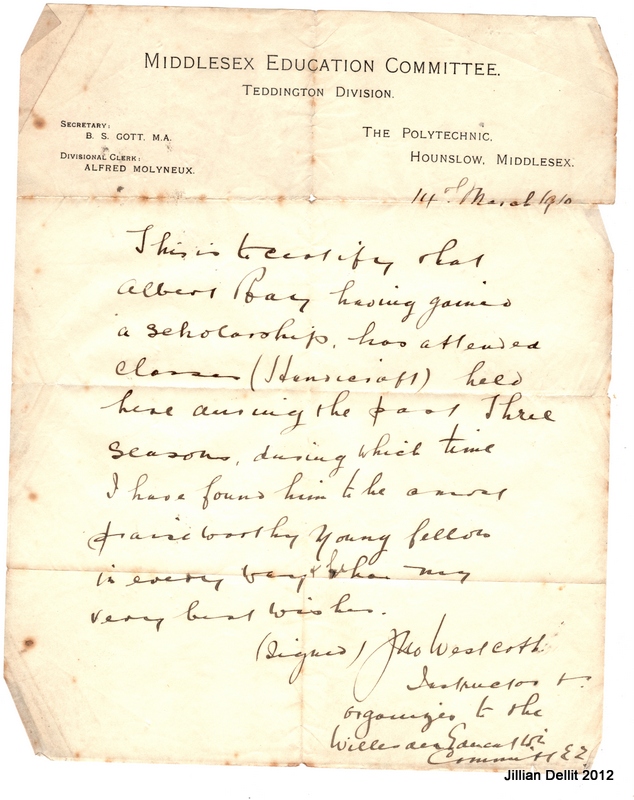
 We do know he won a scholarship in 1908 to attend Handicraft classes at the Houslow Polytechnic, presumably at night and attended until 1910.


He made a chessboard that he kept his whole life.


The back is lined and signed, A.E. Ray Xmas 1908.

We have no record of what else Bert made in his classes. He was, however, always handy and interested in making things. The classes, rather than being recreational, appear to be part of his attempt to improve himself and learn useful skills. His view of education remained practical throughout his life.


Bert's recreation was his cycling, but even that was not free from stress.

Thursday, 22 March 2012

5. The End of Security.

Bert's parents were 21 and 20 respectively when he was born in 1891. Their lives were busy and physically demanding. By the time Bert won his first cycling medal in 1903 they had six children, the youngest just born. We know little of how they manufactured their mineral water but the process was demanding and continuous.

C Ruffles delivering mineral water in England 1914
We do know they made deliveries - primarily to hotels - as part of their business, using a horse-drawn dray or van, and that Bert sometimes helped his father with this task. Horse-drawn vehicles delivered most food and drink at the time - to markets, houses and shops.

In the early 1900s Bert's father developed severe angina. Bert's sister, Dorothy, known as Doll, told the story of her father having an angina attack one day at home, grabbing the curtain and pulling it down on its rod as he fell to the floor.


On 26th June 1907, their father, Albert Ray, had an angina attack while on cart the delivering mineral water. At the corner of Kneller Road and Twickenham Road Whitton, he fell from the van and was unable to be revived.  He was 38. A coroner's inquest was held on 28th June 1907 and issued his death certificate on 29 June 1907. Albert Edward Ray was buried at St Leonard's Heston on 1 July 1907.


Probate was granted on 28 September 1907, awarding Emily eleven hundred and eighty three pounds. It was a significant sum, but not enough to raise six children.  Fred, aged 5 and Les aged 3 needed to be cared for. Bert was 15, Doll was 13, Sid 11 and Stan 7 when their father died. In addition to their grief, their lives changed dramatically.Their secure Edwardian existence was based on an income from a business that depended on the physical labour and mature acumen their father had provided.

They would need to generate income to support the family. The heaviest burden fell on their mother, but the older children carried a share.

Saturday, 10 March 2012

2. Albert Ray's Childhood in the 1890s.

Albert Ray's mother, Emily Grace Higgs,  had two older and three younger sisters as well as two younger brothers, all living within the Heston or Hounslow area. Emily was the first to marry, and Bert was the first grandchild for Emily's parents, David and Lydia Higgs.  Others, however, soon followed. By 1901, two of Emily sisters and one of her brothers were married.

Alice Ada Higgs
Harry Robert Chitty
Her older sister Helen married Charles Keen, a local signwriter.

Her younger sister Alice married Harry Chitty, a whitesmith from Richmond. In 1901, her brother Richard married Katherine Bravery, a commercial clerk from Richmond.


all portraits courtesy of  Peter Furze

Kate Chitty
Her brother Charles married Kate Chitty, grocer's book keeper and sister of Harry, in 1904.


David Higgs
Lydia Higgs
David and Lydia Higgs were market gardeners with 50 acres on the Bath Rd, employing both men and women, some family, some not.

In 1903, David and Lydia must have been very proud of their growing family, as demonstrated by the photo below.

Back row, Albert Ray, unknown, Jack (John) Keen, Middle Row, Harry Chitty, Doll (Dorothy)Ray, Fred Ray, Sydney Ray, Percy Keen, front Row: Stanley Ray, Jessie Higgs ,Janet Chitty, Gordon Chitty, Kate Chitty, Winifred Keen. (It is possible Fred Ray and Winifred Keen should be reversed) . The photo is from the records of Molly Keen. Thanks to Peter Furze.
The Rays were living in High Street Hounslow, the Keens in Cross Lances Rd Hounslow South, the Chitty's in Lydia Villas on the Upton Road, Hounslow North. Richard Higgs and his family lived on the Bath Road market garden property with David and Lydia. The cousins saw a lot of each other in their childhood. There were three National schools in Hounslow in 1903, Hounslow Heath, Heston and Spring Grove and at least some of the children would have attended the same one.


In 1903 Bert also won his first cycling medal, in a competition organised by the Heston and Isleworth United District.


It was an optimistic, relatively secure and predictable world for Albert Ray, surrounded by capable, enterprising adults in an extended family.

Wednesday, 7 March 2012

1. The birth of Albert Edward Ray in 1891

Albert Edward Ray was born in 1891, the first-born child of Albert Edward Ray, mineral water maker and Emily Grace Higgs, market gardener, living on Staines Rd near Hounslow, Middlesex, England.

His parents appear to have been hard-working, supported by extended families and keen to combine their assets and skills as business partners. They were well placed.

Both families had reached Middlesex from Buckinghamshire and were taking advantage of the demand for food and drink that arose from the growth of London where buildings were taking over the agricultural land close to Chelsea and the Covent Garden Markets.

In 1913, John Weathers in his book Commercial Gardening wrote:


Market gardening has been a great industry in the Thames valley for generations, and notwithstanding the operations of the builder, and the enormous growth of the London suburbs, there is still a large area around the metropolis devoted to market gardening. Of course the market gardener is being pushed farther and farther out, but with improved methods of transit, and better roads, the man twenty or thirty miles from London is probably in as good a position as his predecessor was fifty or sixty years ago, when only a dozen miles from Covent Garden. Old market-garden districts like Deptford, Fulham, and Chelsea have been wiped out by the builder, and buildings and roads now take the place of cabbages,rhubarb, fruit trees and bushes that not so many years ago made those neighbourhoods truly rural. This pressure from the centre has naturally driven the market gardener farther out, and such places as Feltham, Ashford, Sipson, Staines,West Drayton, Harmonds-worth, Bedfont, Shepperton, Stanwell, and Cranford, in Middlesex, are becoming covered with fruit and vegetable gardens. ... Chiswick, on the north bank, still contains some of its ancient market gardens, and these extend to Brentford, Isleworth, Heston, and Hounslow; but in these famous market-garden areas the builder is rapidly covering the ground with bricks and mortar.

The mineral water business was also growing.

So Albert Ray was baptised at the less than 20 year-old church, St Paul's Hounslow Heath, on 18th October 1891.


His godparents gave him a Bible, which he kept, all his life, in a hand-stitched white cotton bag.


By 1895 Bert, as he was known to his family, had a brother and a sister and they wore the fashion of the day.

All seemed promising for his future.